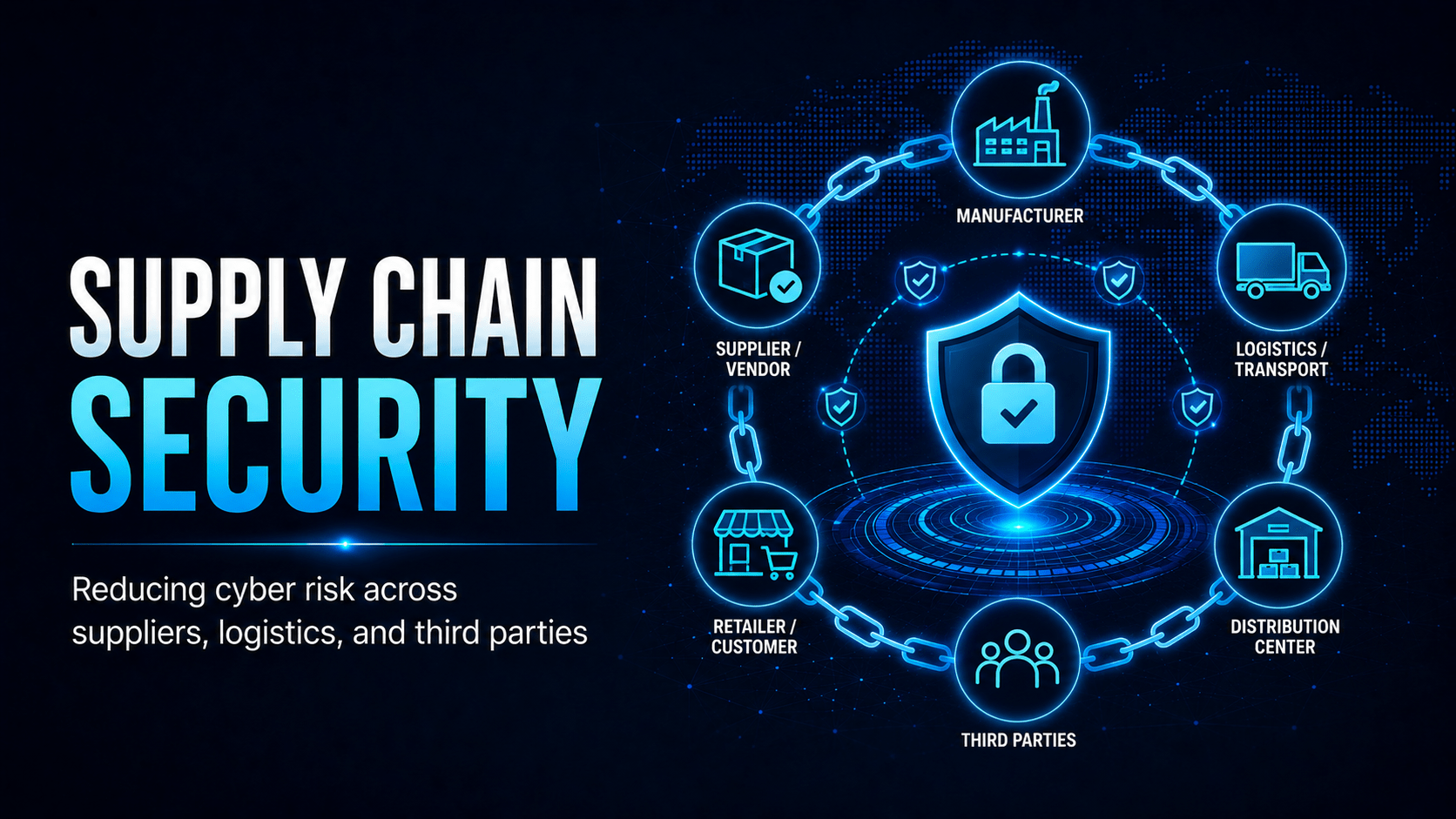
How attackers compromise organisations through vendors and software dependencies, and how to assess and manage third-party risk.
Supply Chain Security
How a Supply Chain Attack Works
Notable Supply Chain Attacks
| Attack | Year | Method | Impact |
|---|---|---|---|
| SolarWinds Orion | 2020 | Malicious update to IT monitoring software | ~18,000 organisations; US govt agencies |
| Kaseya VSA | 2021 | Exploit in MSP remote management tool | ~1,500 businesses via MSP clients |
| Log4Shell | 2021 | Vulnerability in widely-used Java logging library | Hundreds of millions of systems worldwide |
| XZ Utils backdoor | 2024 | Nation-state planted backdoor in Linux utility | Discovered before widespread exploitation |
| npm / PyPI malicious packages | Ongoing | Typosquatting and dependency confusion | Targets developers directly |
Why MSPs Are High-Value Targets
Defending Against Supply Chain Attacks
| Control | What It Addresses |
|---|---|
| Vendor risk assessments | Evaluate suppliers’ security posture before granting access |
| Principle of least privilege for vendors | Scope vendor access to the minimum needed, and time-limit it |
| Monitor vendor activity | Log and alert on actions taken by third-party tools and accounts |
| Software Bill of Materials (SBOM) | Know every component in your software, and track its vulnerabilities |
| Verify update signatures | Confirm software updates are signed by the legitimate publisher |
| Network segmentation | Isolate third-party remote access from sensitive systems |
Mobile Techs IT Consulting
How secure are your suppliers?
The vendors, software and service providers you trust can each undo your own security. Mobile Techs IT Service helps Gold Coast businesses manage third-party risk: vendor security reviews, tightly scoped and monitored vendor access, disciplined patching when supply chain vulnerabilities hit the news, and network segmentation that keeps third-party access away from your critical systems. Home users welcome too, on-site or remote, anywhere in Australia.
Review your supply chain risk Talk to us first
Call 1300 644 588 · office@mobiletechs.com.au
More on our managed IT services and remote security audit.