Why IT Matters in Early Childhood Education
Queensland child care centres now run on digital systems. Enrolment records, attendance sign-ins, CCS claims through the Child Care Subsidy System, developmental observations, medical and allergy information, incident reports, CCTV footage, and parent communication apps all sit on computers, tablets and cloud platforms. Every one of those systems holds sensitive information about children and families.
A centre that loses access to its records — or worse, exposes them — faces far more than an inconvenience. It faces regulatory action, loss of parent trust, and potentially significant financial penalties.
The Privacy Obligations
Most child care providers are covered by the Privacy Act 1988 (Cth) and must comply with the 13 Australian Privacy Principles (APPs). Even small operators with turnover under $3 million can be captured, and many voluntarily opt in as good practice.
Key obligations include:
- Collection limitation — only collect personal information reasonably necessary for the service.
- Notification — tell families what you collect, why, and who you disclose it to (usually via a privacy collection notice at enrolment).
- Use and disclosure — don’t use information for a secondary purpose without consent.
- Data quality and security — take reasonable steps to protect information from misuse, interference, loss, unauthorised access, modification or disclosure.
- Access and correction — families have a right to see and correct their records.
Health information (allergies, medical conditions, medication plans) is sensitive information under the Act and attracts a higher standard of protection.
Notifiable Data Breaches
Under the Notifiable Data Breaches (NDB) scheme, if a centre suffers a data breach that is likely to result in serious harm, it must notify the affected individuals and the Office of the Australian Information Commissioner (OAIC) — generally within 30 days of becoming aware. Recent reforms have increased maximum penalties for serious or repeated privacy breaches substantially.
The Regulatory Layer: NQF and Queensland Requirements
Queensland centres operate under the National Quality Framework (NQF), given effect by the Education and Care Services National Law (Queensland) and the National Regulations, with the Department of Education (Queensland) acting as the state Regulatory Authority.
Relevant to IT:
- Regulations 177–184 cover the storage of records — including the requirement that records be kept confidential, secure, and retained for specified periods (some records must be kept until the child turns 25).
- Quality Area 7 (Governance and Leadership) expects effective administrative systems and appropriate record management.
- CCTV and photography must be handled carefully — consent, storage duration, and access controls all matter.
- Blue Cards — under Queensland’s Working with Children (Risk Management and Screening) Act 2000, people working with children generally require a valid Blue Card issued by Blue Card Services. Centres are also required to maintain a written risk management strategy and keep a register of Blue Card holders.
Where Centres Commonly Fall Short
In practice, we see the same gaps repeatedly:
| Risk | Typical Failure |
|---|---|
| Shared logins | Staff all use one “admin” account, so there’s no audit trail |
| Unpatched systems | Windows machines years behind on updates |
| No backup, or untested backup | Backup exists but has silently failed for months |
| Weak Wi-Fi separation | Parent/guest Wi-Fi on the same network as the enrolment database |
| Unsecured tablets | Sign-in iPads with no passcode, no MDM, no remote wipe |
| Email compromise | Phishing leading to invoice fraud or exposure of family data |
| Offboarding | Departed staff still have access to systems and cloud accounts |
| CCTV | Footage retained indefinitely, accessible from an unsecured DVR on the open internet |
Practical IT Controls for Child Care Centres
Access management
- Individual user accounts for every staff member — no shared logins.
- Multi-factor authentication (MFA) on email, cloud storage and childcare management software.
- Role-based access: educators don’t need financial records; admin staff don’t need to see everything.
- A documented offboarding checklist executed on the day a staff member leaves.
Device and network security
- Endpoint protection on all PCs and servers.
- Automated patching for operating systems and applications.
- Mobile Device Management (MDM) on tablets used for sign-in and observations, with remote wipe capability.
- Segregated networks: separate VLANs/SSIDs for staff, guests/parents, and CCTV/IoT devices.
- Business-grade firewall, not a consumer router from a retail store.
Data protection
- 3-2-1 backup: three copies, two media types, one offsite — with restore testing, not just backup monitoring.
- Encryption at rest and in transit.
- Defined retention and secure destruction schedules aligned to NQF record-keeping requirements.
People and process
- Cyber awareness training — phishing is still the most common entry point.
- A written incident response plan, including who calls OAIC and when.
- A data breach response playbook that a director can actually follow at 7am on a Monday.
Vendor management
- Know where your childcare management platform stores data (onshore vs offshore) and what its security posture is.
- Ensure contracts address data ownership, breach notification, and exit/data return.
How Mobile Techs Can Help
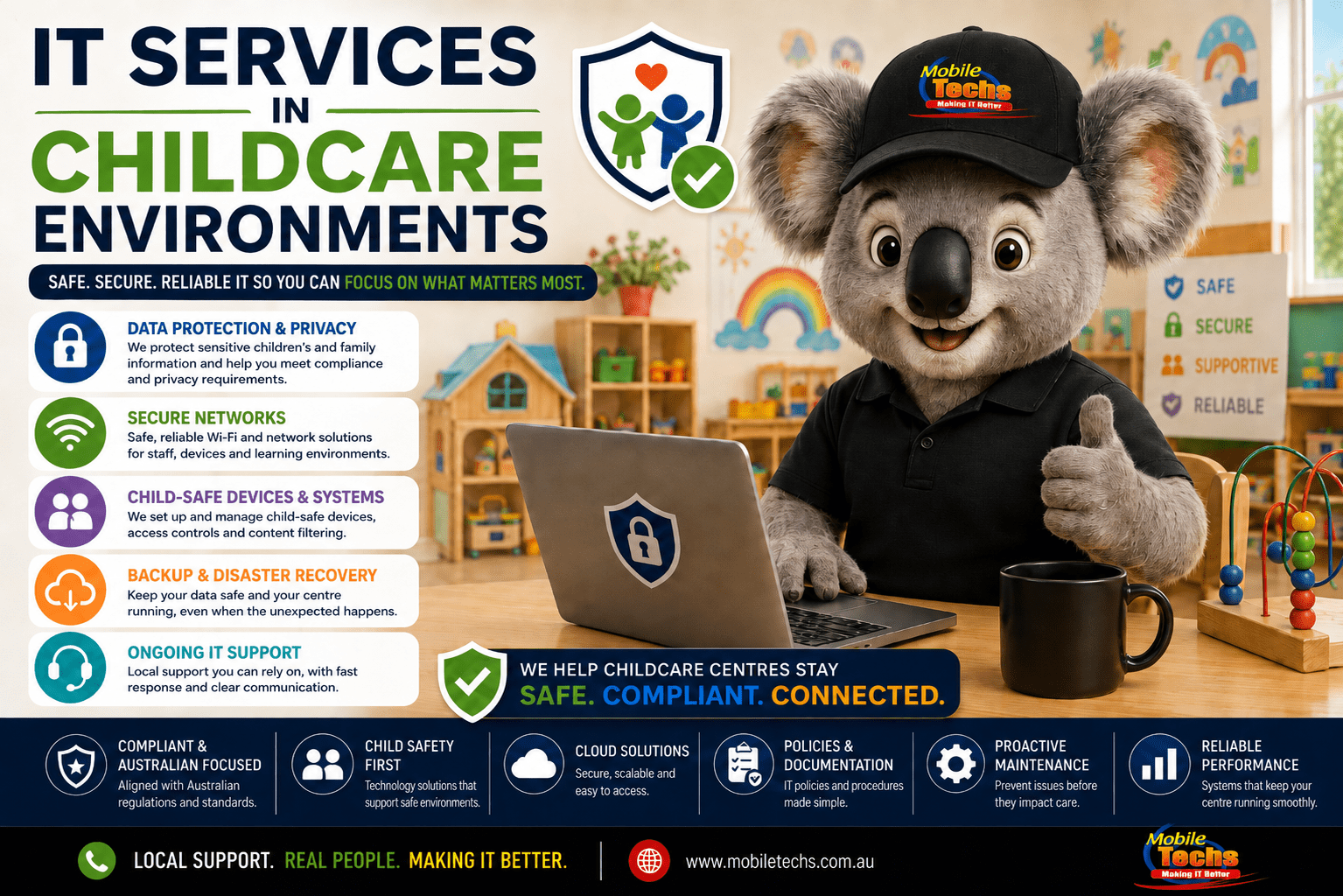
Mobile Techs works with Queensland child care centres to close these gaps and keep systems compliant, secure and running.
Our services include:
- Compliance-aligned IT assessments — a review of your systems against Privacy Act/APP obligations and NQF record-keeping requirements, with a clear, prioritised remediation plan.
- Network design and security — business-grade firewalls, segregated staff/parent/CCTV networks, secure Wi-Fi.
- Backup and disaster recovery — properly configured, monitored, and regularly restore-tested.
- Device management — setup and MDM for PCs and sign-in tablets, including remote wipe.
- Access control and MFA rollout — individual accounts, role-based permissions, and clean offboarding processes.
- CCTV and access system support — secure configuration, appropriate retention, restricted access.
- Email security and anti-phishing — protection against the attacks that most often cause breaches.
- Staff cyber awareness training — practical, jargon-free sessions for educators and admin staff.
- Ongoing managed IT support — proactive monitoring and responsive help when something breaks, so your team can focus on the children.
Blue Card assured. All Mobile Techs staff attending child care sites hold a registered and current Blue Card. Our technicians can work on-site during operating hours with the confidence and clearance your centre, the Queensland Regulatory Authority and your families expect — and we can supply Blue Card details for your centre’s register.
Protect Your Centre — Talk to Mobile Techs
Your educators should be focused on the children, not worrying about backups, breaches or whether your systems would pass a regulator’s scrutiny. Mobile Techs takes that off your plate.
For complete coverage and protection, we recommend our Managed IT Service — a single, fixed-monthly plan that combines proactive monitoring, security, backup, patching, device management and responsive support. Instead of fixing problems after they’ve cost you, we prevent them, keep you compliant, and keep your centre running.
All Mobile Techs technicians hold a registered and current Blue Card, so we can work on-site during operating hours with the clearance your centre and families expect.
Child care IT & security assessment
Would your centre pass a regulator’s scrutiny?
We review your systems against Privacy Act and APP obligations and NQF record-keeping requirements, and hand you a written, prioritised remediation plan — access control, backup and restore testing, network separation, tablet management, CCTV retention and offboarding.
All Mobile Techs technicians hold a registered and current Blue Card, so we can work on-site during operating hours — and we can supply Blue Card details for your centre’s register.
Book an assessmentTalk to us first
Call 1300 644 588 · office@mobiletechs.com.au
Serving child care centres across the Gold Coast and South East Queensland on-site, and Australia-wide remotely.
More on our managed IT services and remote security audit.
This article provides general information only and is not legal advice. Centres should seek professional advice regarding their specific privacy and regulatory obligations.