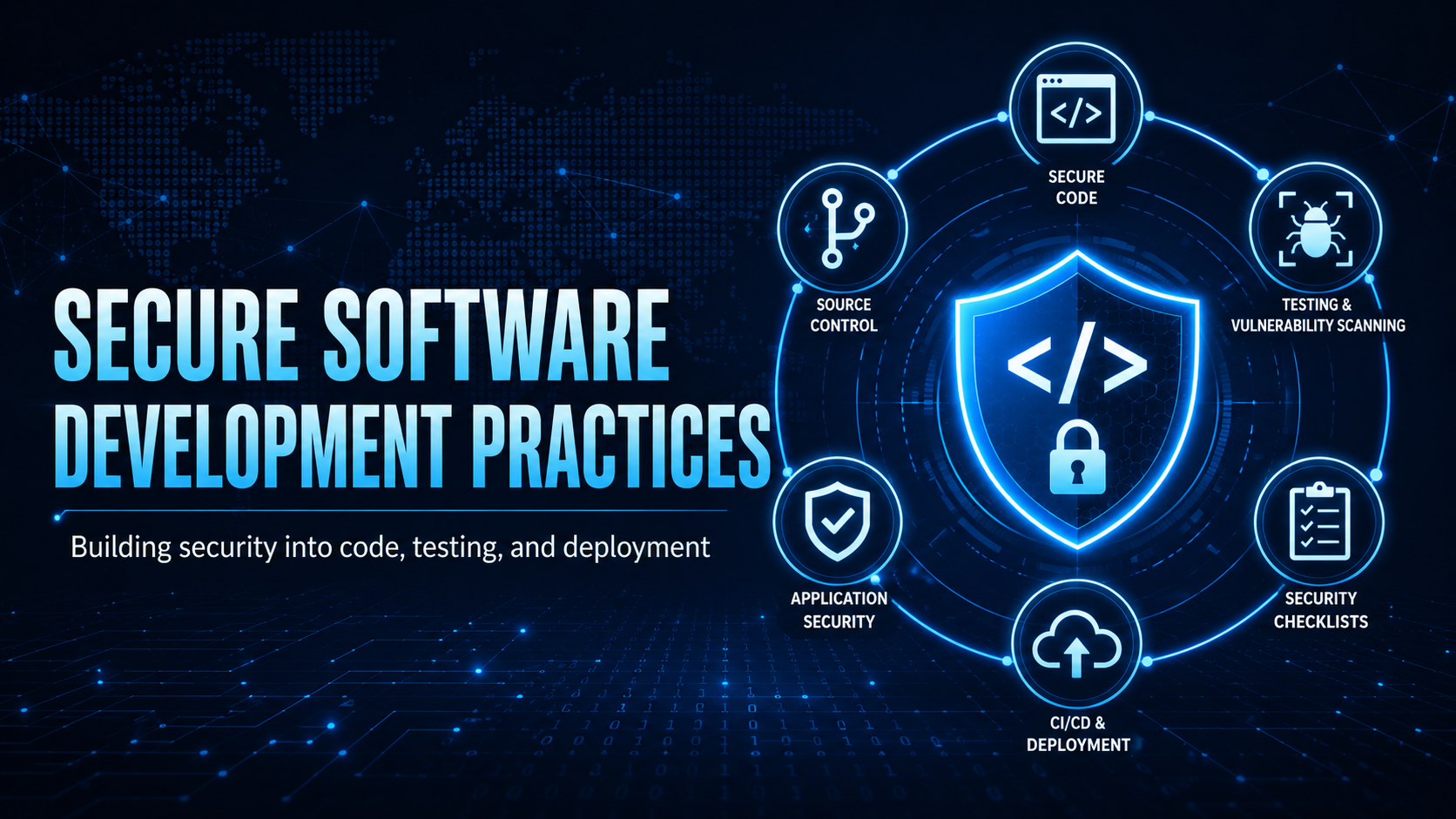
The OWASP Top 10, shifting security left in the development lifecycle, and how to handle secrets and dependencies.
Secure Software Development Practices
Build security into software from the start. Fixing a vulnerability in production costs about 30 times what it costs to catch during design.
Shift Left: Security at Every Stage
The OWASP Top 10
The Open Web Application Security Project (OWASP) publishes the most common web application vulnerabilities. Developers should know these:
| Rank | Vulnerability | Simple Example |
|---|---|---|
| A01 | Broken Access Control | User can access another user’s data by changing the URL |
| A02 | Cryptographic Failures | Storing passwords in plain text; using HTTP not HTTPS |
| A03 | Injection | SQL injection: '; DROP TABLE users;-- in a login field |
| A04 | Insecure Design | No rate limiting on login, so an attacker guesses passwords indefinitely |
| A05 | Security Misconfiguration | Default admin credentials left enabled |
| A06 | Vulnerable Components | Using a library with a known CVE |
| A07 | Auth Failures | Session tokens that never expire |
| A08 | Integrity Failures | Deploying code without verifying its source |
| A09 | Logging Failures | No audit trail of who accessed what data |
| A10 | SSRF | App fetches URLs from user input without validation |
SQL Injection: A Visual Example
⛔ Important
Never concatenate user input directly into SQL queries or shell commands. Use parameterised queries, also called prepared statements. This one practice prevents the most common class of serious web application vulnerabilities.
Secrets Management
API keys, database passwords, and credentials must never be stored in code:
⚠ Warning
Developers commit thousands of AWS keys, database passwords and API secrets to public GitHub repositories every day. Once a secret reaches version control history, treat it as compromised. Deleting it does not remove it from git history. Use environment variables or a secrets manager (HashiCorp Vault, AWS Secrets Manager) instead.
Dependency Security (SCA)
Your application probably pulls in hundreds of third-party libraries, and any of them may carry vulnerabilities:
- Run Software Composition Analysis (SCA) tools to detect vulnerable dependencies
- Subscribe to vulnerability notifications for libraries you use
- Update dependencies on a schedule, not only when a feature requires it
Mobile Techs IT Consulting
Building or buying software for your business?
One vulnerable app or misconfigured server can expose everything behind it. Mobile Techs IT Service helps Gold Coast businesses keep their software stack secure: vetting and hardening business applications, keeping systems and dependencies patched, locking down default configurations, and securing the websites and servers you rely on. Home users welcome too, on-site or remote, anywhere in Australia.
Get your applications security-checked Talk to us first
Call 1300 644 588 · office@mobiletechs.com.au
More on our managed IT services and remote security audit.