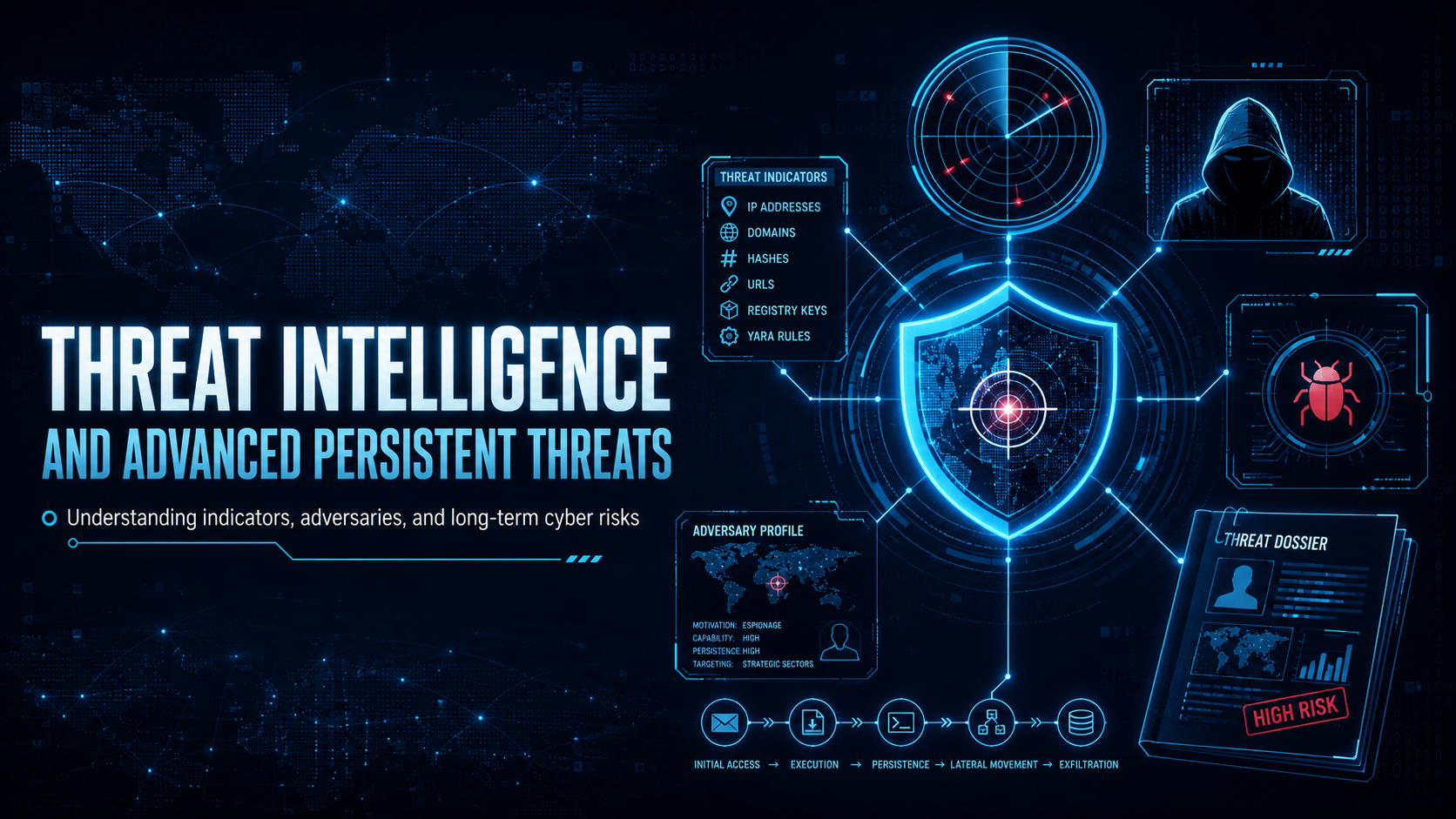
How advanced adversaries operate, how threat intelligence informs defence, and how MITRE ATT&CK maps attacker behaviour.
Threat Intelligence and Advanced Persistent Threats
Advanced Persistent Threats (APTs) sit at the sophisticated end of the attacker spectrum: nation-state actors and organised criminal groups with deep resources, patience and a named target.
APT vs Opportunistic Attacker
The MITRE ATT&CK Framework
MITRE ATT&CK is a public knowledge base of adversary tactics and techniques drawn from real-world observations. Security teams use it to understand how attackers operate and to map their detections.
Threat Intelligence
Threat intelligence tells you who is attacking, how they operate, and which indicators of compromise (IoCs) to look for. Sources include:
- ACSC Alerts. cyber.gov.au publishes advisories on active threats targeting Australian organisations
- MITRE ATT&CK. Documented TTPs (Tactics, Techniques, Procedures) of known threat groups
- OSINT feeds. Open-source intelligence from security researchers
- Commercial feeds. Real-time IoC lists covering malicious IPs, domains and file hashes
✓ Key Point
For most staff, threat intelligence means one thing: read ACSC advisories. When the ACSC publishes a critical advisory about a vulnerability being actively exploited, real attackers are using it against Australian organisations right now. Your IT team should treat these as urgent, and if they tell you to patch something immediately, that is why.
Indicators of Compromise (IoCs)
An IoC is evidence that a system may have been compromised. Common IoCs include:
- Known malicious IP addresses or domains in network logs
- File hashes matching known malware samples
- Unusual process names or registry keys
- Unexpected outbound connections, especially to overseas IPs on unusual ports
- Accounts logging in from multiple countries simultaneously
⚠ Warning
APT groups target IT service providers (MSPs) because compromising one MSP opens access to every client at once, a technique called “island hopping.” As an MSP employee, you are a higher-value target than a typical enterprise staff member. Treat your credentials and remote access tools with corresponding care.
Mobile Techs IT Consulting
Would you know if an attacker was already inside?
Sophisticated attackers sit in a network for months before they act. Mobile Techs IT Service helps Gold Coast businesses stay ahead of the threat: endpoint detection and response, network monitoring, prompt patching of actively exploited vulnerabilities, and defences aligned with ACSC guidance. Home users welcome too, on-site or remote, anywhere in Australia.
Book a threat readiness assessment Talk to us first
Call 1300 644 588 · office@mobiletechs.com.au
More on our managed IT services and remote security audit.