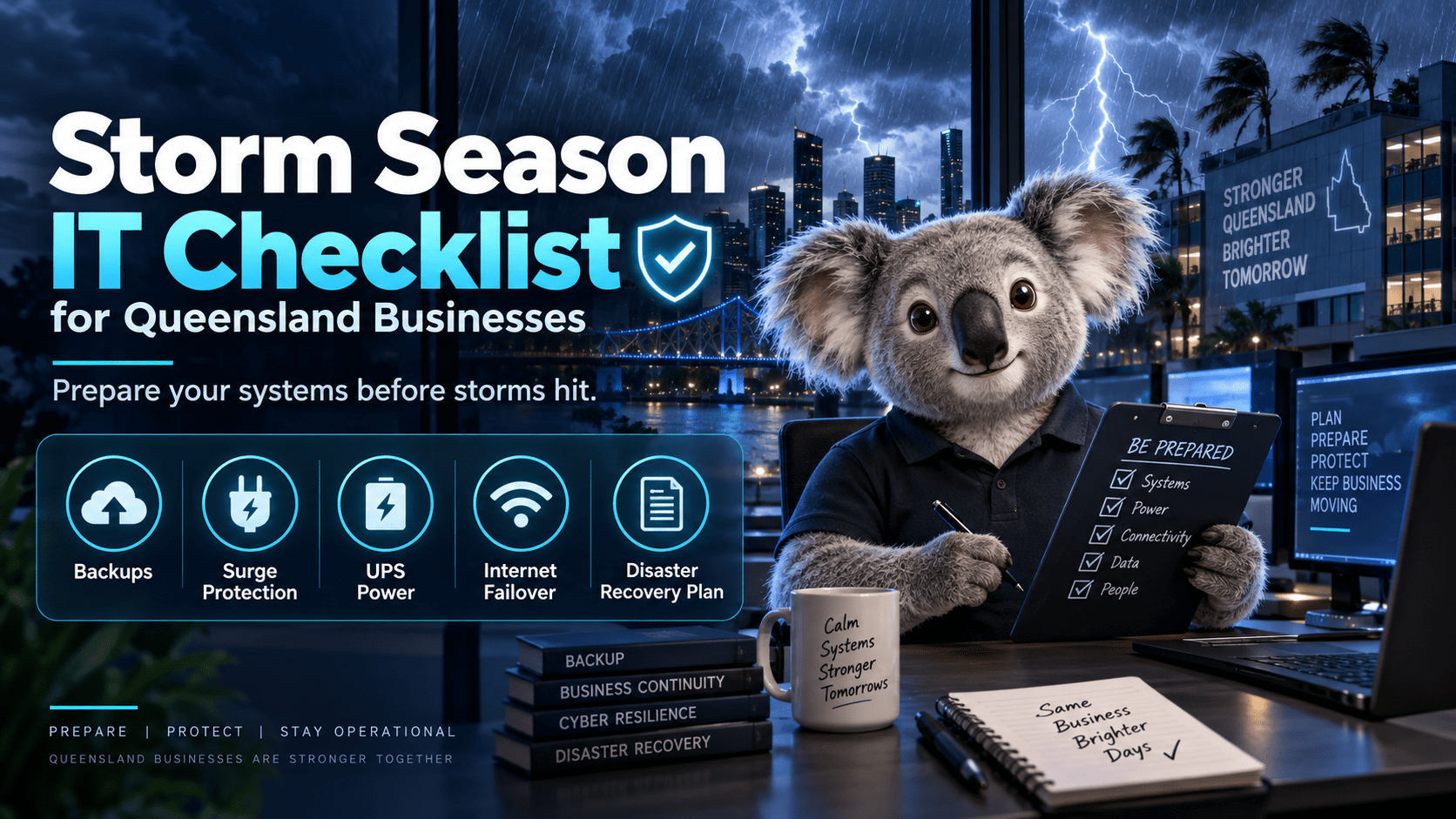
Storm season on the Gold Coast runs from October to April. Somewhere in that window the power will drop mid-afternoon, come back twice, and go again. The damage to your IT is done in the second or two of that flicker, not in the hours the lights are off. This is what to do in September so that January is an inconvenience rather than a claim.
What a storm actually does to a small office
| Event | What we get called out for afterwards |
|---|---|
| Power flicker | A server that lost power mid-write and will not boot. A NAS rebuilding its RAID for two days. Every desktop asking to run disk repair. The PBX that came back with no config because it corrupted on the way down. |
| Surge from a nearby strike | Dead network switch. Dead NBN box, which on HFC arrives via the coax lead-in and takes the router with it. Dead PoE ports on a switch that otherwise works, discovered a week later when the cameras stop. |
| Outage of several hours | UPS batteries that lasted six minutes because they were installed in 2019 and never replaced. Phones down because the VoIP handsets had no power. A generator that ran the lights and not the comms cabinet. |
| Water | A comms rack on the floor of the ground-floor storeroom. A ceiling-mounted access point directly under the spot where the roof leaks. The external NBN lead-in filling with water and dropping sync every time it rains for the next six months. |
| NBN or mobile tower down | Power is on, nothing else is. EFTPOS declines every card. The cloud practice software is a login screen. Nobody knows the phone number of the person who can decide to send staff home. |
Power: the UPS is the whole game
An uninterruptible power supply does two jobs. It filters the flicker so the server never sees it, and it gives you enough minutes to shut down cleanly when the outage is a real one. It is not a generator and it does not need to be. Most Gold Coast outages are under an hour; you are buying time to close the books, not to keep trading.
Size it to the cabinet, not the office
The server, the NAS, the router, the NBN box, the switch and the PBX. Add up their draw (the labels overstate it; a small server pulls 100 to 200 W) and buy a UPS rated at roughly double that. A 1500 VA line-interactive unit covers most small comms cabinets for 20 to 40 minutes. Do not plug the laser printer into it.
Connect the USB cable
The UPS talks to the server over USB or the network and tells it to shut down at 20 percent battery. Without that cable the server runs until the battery dies and you are back to the corrupted-disk scenario. A Synology NAS can do the same, and can relay the signal to other devices.
Replace the battery every three years
In a Queensland cupboard with no air conditioning, closer to two. Write the install date on the front in marker. Most units will run a self-test from their software; run it now, in September, and read the estimated runtime it reports.
Desktops get a small one or nothing
A desktop that loses power loses unsaved work and little else, provided the files live on the server or OneDrive. A cheap 650 VA unit under reception is worth it for the EFTPOS terminal and the phone. Laptops have their own battery.
A generator needs a transfer switch. Plugging the comms cabinet into a portable generator through the back door works once. Plugging a generator into the building’s wiring without a proper changeover switch is illegal, can kill a lineworker, and will not be covered when something burns. If the business needs to trade through a long outage, an electrician fits a manual transfer switch on the circuits that matter, and the UPS bridges the gap while someone pulls the cord.
Surge
Lightning does not have to hit the building. A strike on the street feeds a spike up the power, the NBN lead-in and any copper that still runs outside. A UPS absorbs the spike on the power side. For the other paths:
| Path in | Protection |
|---|---|
| NBN HFC coax | The most common surge casualty on the Gold Coast. A coax surge arrestor between the wall plate and the NBN box costs $30. Ask NBN Co or your provider whether the lead-in is earthed at the external wall; older Foxtel installs often are not. |
| NBN FTTP fibre | Glass does not conduct. The only surge path is the box’s own power supply, which goes on the UPS. One of the quieter reasons to take the fibre upgrade. |
| Ethernet to the shed, the sign, the gate | Any copper network cable that leaves the building carries a strike inside. Use a fibre run for anything outdoors over 20 metres, or an outdoor Ethernet surge protector at each end. Cheap outdoor cameras on long copper runs kill switches every summer. |
| Power boards | A surge-rated board with a joules figure and an indicator light, not the $8 four-way. They wear out with each hit; if the light is off, the protection is gone. |
The checklist
Do this once in September and again after the first big storm.
- UPS self-test run, runtime noted, batteries replaced if under 15 minutes
- UPS shutdown cable connected and tested by pulling the plug
- Off-site backup verified with a real restore (see the 3-2-1 article)
- Comms cabinet off the floor and away from the ceiling drip line
- Coax and outdoor Ethernet surge protectors fitted
- 4G failover SIM in the router, tested by unplugging the NBN
- Photos of every serial number in the rack, for insurance
- Save and close everything on the desktops
- Shut down the server cleanly if the office is closing
- Unplug the printers and anything without a UPS from the wall, not just off at the switch
- Laptops charged and taken home
- The one-page contact list printed: staff mobiles, IT, electrician, landlord, insurer, the NBN outage page
- Wait ten minutes. The grid often drops again while Energex restores sections.
- Power up in order: NBN box, router, switch, then server, then everything else
- Check the NAS is not rebuilding and the server event log is clean
- Confirm the backup job ran that night
- Walk the building for dead PoE devices: cameras, access points, phones
Trading without the internet
The Gold Coast lost mobile and NBN service across large areas for days during Cyclone Alfred in 2025. Power was back in many suburbs before the towers and the fibre were. A business that can take payments, see its bookings and ring its customers with no internet is a business that opens the day after.
For most, that means three things. A 4G or 5G SIM in the router, on a different carrier from the staff mobiles, so one tower outage does not take both. A manual EFTPOS process agreed with the bank, or an offline-capable terminal. And a printed copy of tomorrow’s appointments or jobs, taken home by whoever opens up, every night of the season.
Need a hand?
Storm-proofed before the first cell rolls in
We size and fit the UPS, connect the shutdown, add the surge protection and the 4G failover, and test the lot by pulling the plug while you watch. Under a Managed IT contract the battery replacements and the September check are on our calendar, not yours.